Resources
Restoring Mediterranean Seagrass: Bringing Science, Policy and Local Action Together in Marseille
Seagrass Blue brought scientists, public authorities, conservation organisations and maritime stakeholders together in Marseille to discuss the future of Mediterranean seagrass restoration.
Protecting existing seagrass meadows is essential.
But where ecosystems have been damaged and natural recovery is limited, seagrass restoration also has a role to play.
In Marseille, scientists, public authorities, conservation organisations and maritime professionals came together to discuss how the Mediterranean can move from restoration ambitions to effective action.
What does successful seagrass restoration look like?
Marine restoration does not happen through science alone.
It requires researchers, public authorities, conservation organisations, maritime professionals and other stakeholders to come together around a shared understanding of what restoration should achieve and how it can happen in practice.
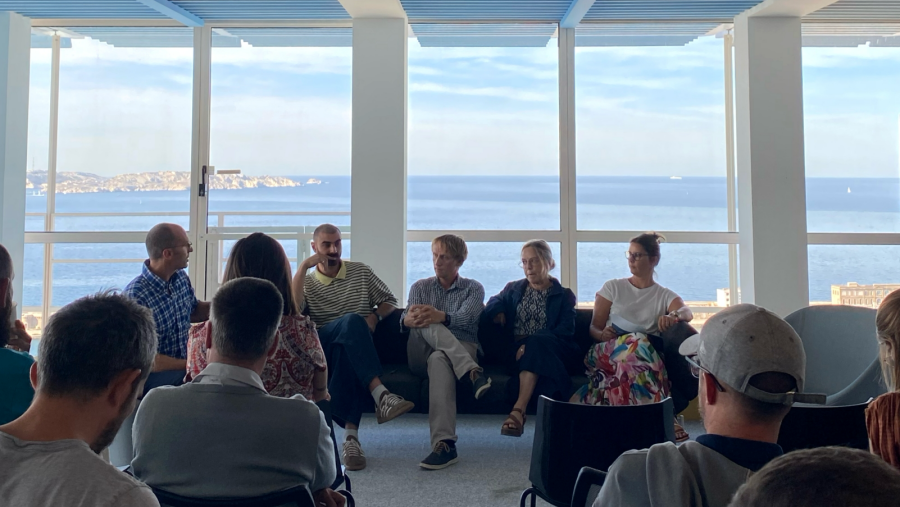
That was the focus of a Seagrass Blue event held on 21 September at La Marseillaise Tower in Marseille, with the support of Plan Bleu. Where participants came together to discuss the challenges and opportunities for ecological restoration at sea, with a particular focus on Mediterranean seagrass meadows and Posidonia oceanica.
The discussions explored a central question: how can we protect what remains, support natural recovery and identify where additional restoration efforts may be appropriate?
Seagrass Blue intro video for mediterranean seagrass restoration meet-up held in Marseille in September 2026.
Start by protecting existing seagrass meadows
One clear message from the Marseille discussions was the importance of passive, or natural, restoration.
Passive restoration focuses on reducing or removing the pressures responsible for its degradation. When those pressures are addressed, an ecosystem may be able to recover through its own natural processes.
For Mediterranean seagrass meadows, this means prioritising the protection of existing habitat and tackling the causes of damage. Depending on the location, these may include physical disturbance from anchoring, coastal development and other activities that affect the seabed or water quality.
This approach is particularly important for Posidonia oceanica, a slow-growing marine plant that forms extensive underwater meadows across the Mediterranean. These meadows provide habitat for marine life, support biodiversity, help stabilise seabed sediments and store carbon over long periods. Their ecological value makes protecting established meadows a critical priority.
Where damage is caused by ongoing pressures, planting new seagrass without addressing those underlying problems is unlikely to provide a lasting solution.
When is active seagrass restoration appropriate?
Natural recovery is not always possible, or may be limited by the extent of the damage and the condition of the surrounding ecosystem.
In such cases, active restoration should be considered as a complement to conservation measures. It involves direct intervention to help an ecosystem recover, potentially including the re-establishment of seagrass in suitable locations.
At the Marseille event, participants explored how different restoration approaches can fit within a broader strategy for marine biodiversity.
The objective is to understand where natural and active restoration are appropriate, guided by scientific evidence.
Putting restoration into practice
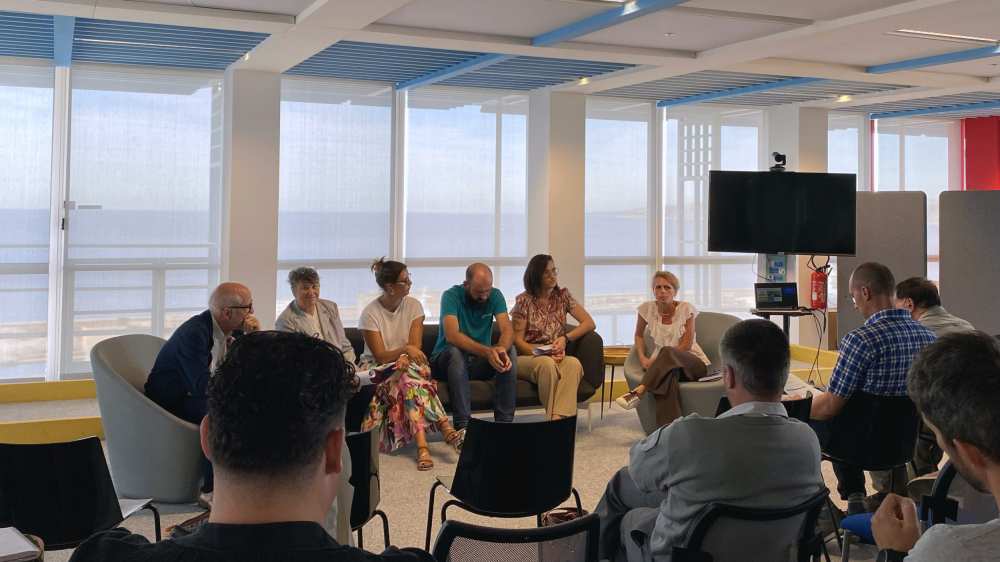
An effective restoration project requires coordination, resources and a clear framework for action.
The morning’s discussions were organised around two round tables.
The first explored restoration methods, priorities and existing regulations. Participants considered what a successfully restored ecosystem should look like, which approaches are appropriate in different circumstances, and how lasting ecological recovery can be assessed.
The second focused on the regulatory and financial tools needed to turn restoration plans into practical projects at sea.
These questions are closely connected. A scientifically sound proposal must also account for the local context, applicable authorisations, funding requirements and the people responsible for protecting and managing the marine environment. Monitoring is equally important.
Bringing science, policy and local stakeholders together
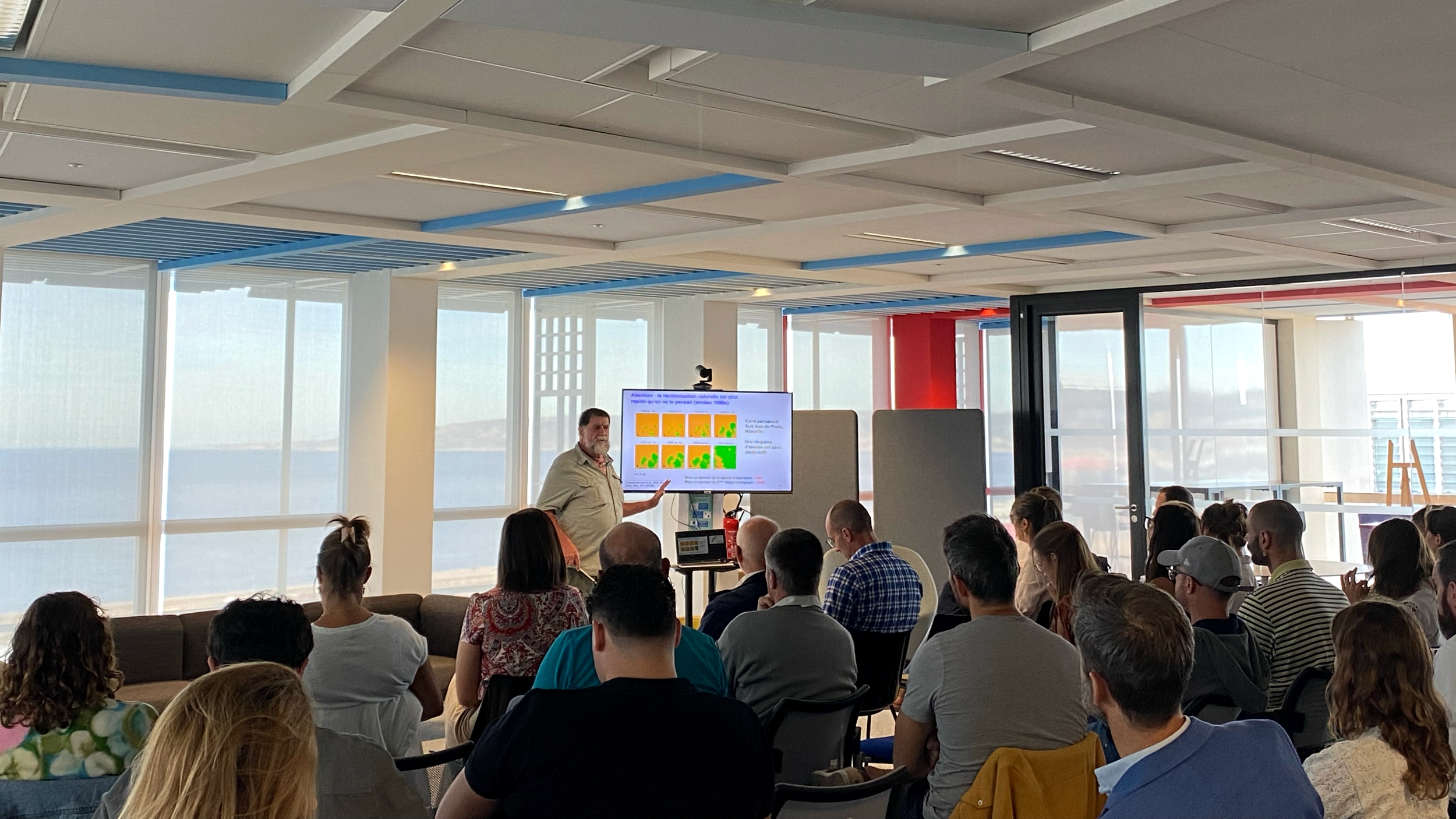
Professor Emeritus Charles-François Boudouresque opened the event with a presentation on Posidonia oceanica, providing a scientific foundation for the discussions that followed.
The round tables brought together expertise from local and regional government, environmental agencies, conservation organisations, research and independent specialists.
Contributors included representatives from Mairie de Grimaud, Plan Bleu, Agence de l’eau Rhône Méditerranée Corse, WWF France, DREAL Provence-Alpes-Côte d’Azur, Conservatoire du littoral and the Office français de la biodiversité.
Maritime and private-sector representatives also joined the conversation, bringing perspectives on the practical realities of operating at sea and developing environmental projects.
As Sophie Caplanne of DREAL Provence-Alpes-Côte d’Azur shared:
“It is extremely enriching to exchange ideas and share the public policies we are working to implement.”
Shared understanding can help identify common priorities, clarify challenges and support more informed decisions about future restoration efforts.
Collaboration is part of the solution
For Seagrass Blue, the event was an opportunity to listen, exchange knowledge and contribute to the wider conversation around seagrass restoration in the Mediterranean.
As Chris, Co-Founder of Seagrass Blue, reflected: “Restoration is not only about science and technology, it also requires collaboration.”
The Marseille discussion highlighted the importance of bringing different perspectives together to identify common ground, share knowledge and support the development of effective approaches to restoring Mediterranean seagrass ecosystems.
A sincere thank you to everyone who joined the discussion, shared their expertise and helped make the event such a valuable exchange.
Nous contacter
Aidez-nous à planter 10 hectares d'herbiers marins
Contactez notre équipe pour découvrir comment votre soutien peut avoir un impact mesurable sur l'environnement.
Notre prochain objectif est clair : planter 10 hectares d'herbiers marins pour améliorer l'élimination du carbone et protéger la vie marine.