Resources
Turning maritime operations into seagrass restoration impact
How maritime operators can integrate biodiversity recovery into the waters they already operate in.
How can maritime activity actively contribute to ocean recovery?
For decades, maritime sustainability has focused on reducing environmental impact through cleaner fuels, operational efficiency and emissions reduction. But decarbonisation only addresses one side of the maritime sector’s environmental footprint.
The other side – the direct, physical impact that ports, shipping lanes and coastal operations have on the marine ecosystems beneath and around them – has historically had far less visibility, and less standardised reporting.
A new model is emerging to close that gap: rather than only minimising harm, maritime organisations can actively contribute to restoring the marine ecosystems that support their operations.
Seagrass restoration is becoming a promising nature-based solution for improving marine biodiversity, strengthening coastal resilience and delivering measurable environmental impact across the Mediterranean.
The coastal footprint
Maritime activity intersects with seagrass ecosystems in ways that are well documented, even if operators rarely quantify them:
- Anchoring: chains and swing circles can scar and uproot meadows, especially in high-traffic anchorages.
- Dredging: channel maintenance and port construction can remove seabed habitat directly and raise turbidity, blocking the light seagrass needs to survive.
- Port and coastal infrastructure development: land reclamation, breakwaters and terminal expansion can permanently displace or fragment meadows.
- Pollution and runoff: fuel residues, ballast discharge and nutrient loading can degrade water quality in the same coastal zones where seagrass grows.
These pressures have generally sat outside standard sustainability reporting, which has focused on emissions. That’s changing, though: regulators, investors and charterers increasingly expect operators to understand and report on ecosystem impact too.
So operators who measure, address and report on their coastal footprint now are better placed for the reporting environment ahead, and stand out for getting there early.
This is where Seagrass Blue fits in. We help maritime organisations understand their relationship with the coastal ecosystems they operate in, take direct action to restore them, and report on that action with verifiable data.
Why this matters now
Seagrass ecosystems rank among the most valuable coastal habitats, and among the most threatened:
1/5
of the world’s largest fisheries rely on seagrass meadows as a nursery habitat (UNEP)
29%
of known seagrass areas in the world have disappeared since 1879 (PNAS)
30x
faster carbon capture than tropical rainforests, per unit area (WWF)
For maritime operators, these numbers translate into opportunity: a chance to integrate biodiversity recovery into waters they already operate in, and to point to concrete, verified action when stakeholders ask how they’re addressing their ecosystem footprint.
Engineered seagrass restoration systems
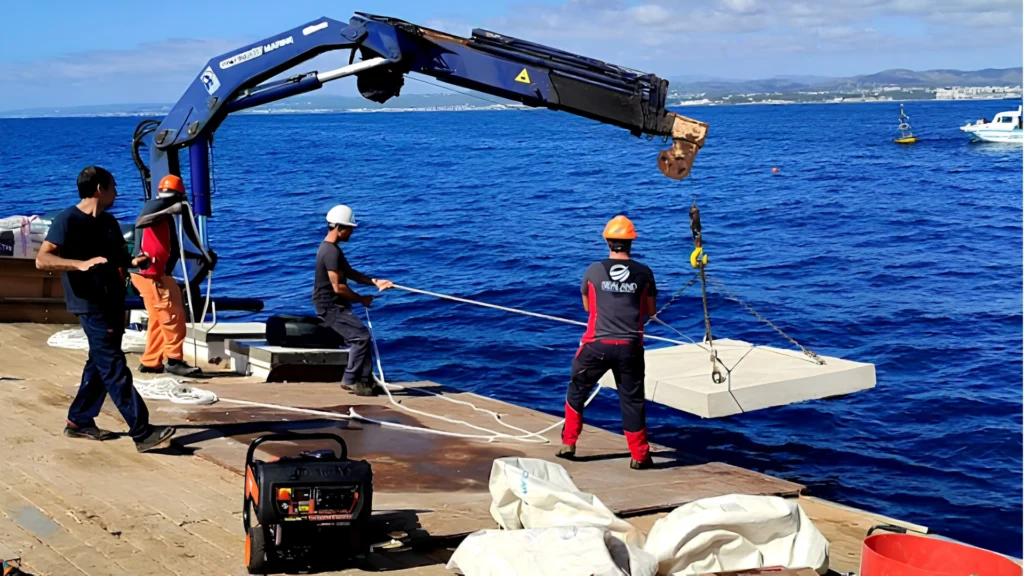
Seagrass Blue’s nursery pod during deployment. Designed to protect young seagrass while generating long-term ecological monitoring data.
Large-scale restoration requires more than planting seagrass. Successful projects require engineering, monitoring and long-term ecological management.
Seagrass Blue is developing engineered restoration systems designed specifically for Mediterranean coastal environments.
Our approach uses seabed-anchored nursery pods that protect young seagrass during its most vulnerable stages, improving establishment success while collecting the environmental data needed to measure outcomes.
Each deployment combines:
- Engineered seabed nursery pods
- Seagrass cultivation and transplantation
- Environmental monitoring infrastructure
- Underwater imaging and data collection
- Monitoring, Reporting and Verification (MRV)
Together, these systems support scalable restoration while generating measurable evidence of ecological recovery.
The hectare model
To scale restoration effectively, impact needs to be measurable.
For that reason, we structure restoration into hectare-scale programmes that pair infrastructure with continuous ecological monitoring.
Each hectare is a complete system: deployment, monitoring, and ecological reporting; all bundled together. This allows maritime operators to:
- Align investment with measurable ecological outcomes
- Track biodiversity recovery over time
- Report verifiable ESG performance
- Scale impact across multiple coastal zones
Maritime organisations are well placed to put this model to work: they already operate in the coastal zones that need restoring, hold a long-term regional presence, and face growing pressure to report on biodiversity commitments.
Rather than funding restoration elsewhere as an offset, they can improve the very waters they operate in and depend on.
Built for Mediterranean conditions
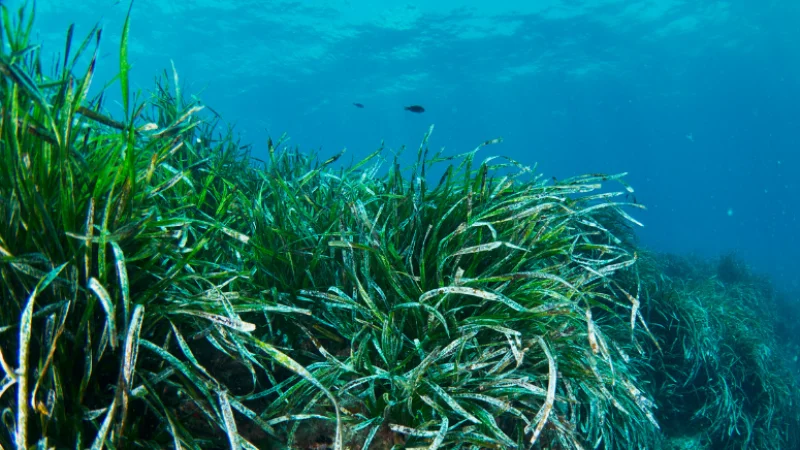
The Mediterranean is home to some of the world’s most important seagrass habitats, including Posidonia oceanica and Zostera marina specie, both under sustained pressure from the coastal activity described above.
Seagrass Blue designs its restoration systems specifically for these conditions.
Our pilot programme combines engineered nursery pods with continuous environmental monitoring, underwater imaging and ecological data collection to evaluate performance under Mediterranean coastal conditions.
The long-term objective is to develop restoration systems that can be deployed repeatedly across multiple sites while generating robust scientific evidence to support large-scale restoration.
Working with maritime operators
Every maritime organisation operates in a different environmental and operational context, so we design each programme collaboratively around:
- Restoration area (hectares)
- Site suitability assessment
- Deployment strategy
- Monitoring and reporting framework
- Biodiversity objectives
- Long-term maintenance
This collaboration enables biodiversity recovery to be integrated into existing maritime operations, rather than a separate environmental initiative.
Explore a maritime restoration pilot
We’re currently developing new coastal restoration sites and multi-hectare deployment programmes across Mediterranean maritime zones.
or request a partnership model for a full breakdown of restoration scope, cost and reporting for your operations.
Nous contacter
Aidez-nous à planter 10 hectares d'herbiers marins
Contactez notre équipe pour découvrir comment votre soutien peut avoir un impact mesurable sur l'environnement.
Notre prochain objectif est clair : planter 10 hectares d'herbiers marins pour améliorer l'élimination du carbone et protéger la vie marine.